Preschool Math Worksheet, Back to School: A Practical Tool for Early Learning Integration
When planning early learning support for the new academic year, a Preschool Math Worksheet, Back to School isn’t just another printable—it’s a deliberate bridge between readiness and routine. Designed for children aged 2–9 (toddlers through 3rd grade), this resource functions as both a developmental scaffold and a logistical asset for educators, homeschooling parents, and independent publishers preparing materials for the seasonal demand spike around August and September. Its 20-page structure—optimized at 8.5 x 11 inches, print-ready in high-resolution PDF and JPG—makes it immediately deployable across multiple workflows without redesign or formatting overhead.
Where It Fits in the Broader Learning & Publishing Workflow
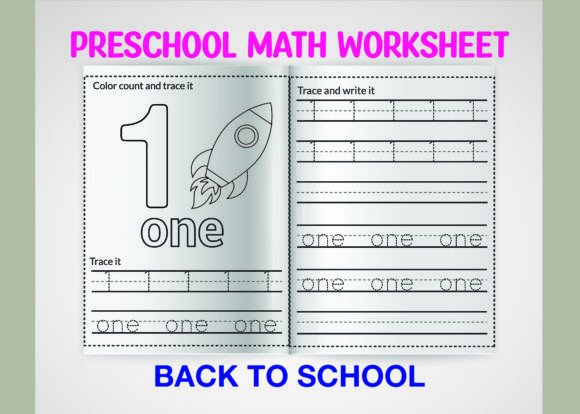
A Preschool Math Worksheet, Back to School enters the process at three distinct inflection points: preparation, delivery, and extension. Before school starts, it supports skill activation—helping children re-engage with number recognition, fine motor control, and visual discrimination after summer breaks. During classroom or home-based instruction, it serves as a low-stakes, high-engagement activity that complements direct teaching without requiring real-time supervision. After formal lessons, it doubles as reinforcement—reinforcing concepts like counting 1–10, simple addition and subtraction, and number tracing through repetition paired with coloring.
This dual-purpose design means it doesn’t replace core curriculum but integrates cleanly alongside it. For example, a kindergarten teacher might use pages from the workbook during morning tub rotations while simultaneously tracking progress on a standards-aligned checklist. A freelance educator creating supplemental content for Teachers Pay Teachers can extract individual pages as standalone digital downloads—no cropping or resizing needed—thanks to the consistent 300 DPI resolution and bleed-free layout.
How It Interacts With Other Tools and Systems
Compatibility is built into the file architecture. The inclusion of both a single PDF and 20 individual JPGs allows users to choose their integration path based on platform requirements. KDP publishers upload the PDF directly; Canva-based creators drop JPGs into editable templates; Google Classroom instructors embed JPGs into assignments or convert them to interactive PDFs using tools like Adobe Acrobat or Kami. No proprietary software is required—just standard PDF viewers, image editors, or LMS platforms.
It also pairs naturally with physical tools: dry-erase sleeves for repeated practice, dot markers for tactile number identification, or fine-tip crayons for controlled coloring. When used alongside phonics flashcards or social-emotional check-in sheets, the Preschool Math Worksheet, Back to School contributes to a balanced “morning starter” rotation—offering cognitive, motor, and emotional grounding in under 15 minutes.
Practical Implementation Across User Roles
Educators and Curriculum Coordinators: Use page sequencing intentionally. Start with number tracing (pages 1–5), move to coloring-by-number (6–10), then introduce addition/subtraction visuals (11–15), and close with open-ended drawing prompts tied to math vocabulary (e.g., “Draw 3 apples and 2 bananas—how many fruits?”). This mirrors developmental progression and aligns with NCTM’s early math guidelines.
Homeschooling Parents: Treat the workbook as a flexible rhythm anchor—not a daily requirement, but a reliable option when energy is low or attention spans are short. Keep it clipped in a binder with a pencil pouch nearby. Rotate pages weekly rather than forcing completion. Consistency matters more than speed.
KDP Publishers and Digital Product Creators: Leverage the dual-format delivery (PDF + JPG) to expand your offer stack. Bundle the workbook with a companion “Back to School Readiness Checklist” or “Parent Guide to Early Math Milestones” to increase perceived value. Because all assets are print-ready and dimensionally standardized, you avoid last-minute QA delays before upload—critical during peak back-to-school listing windows.
Preparation, Quality Control, and Long-Term Usability
Preparation is minimal by design—but not zero. Before distribution, verify printer settings: select “actual size” (not “fit to page”) and enable “high-quality printing” mode. For digital reuse, rename files descriptively (e.g., back-to-school-math-tracing-03.jpg) to maintain organization across cloud folders or CMS libraries. Avoid generic names like “page3.jpg”—they erode searchability and version control.
Quality control happens at two levels. First, visually inspect each JPG for clarity—especially number strokes and line thickness. Second, test-print one full spread on standard 20 lb. paper to confirm contrast and legibility. If lines appear faint, adjust brightness/contrast in your PDF viewer’s print dialog before final output. These checks take under five minutes and prevent bulk reprinting later.
Long-term usability hinges on modularity. Because each page stands alone, you can repurpose content across contexts: convert tracing pages into laminated center activities, isolate coloring sections for occupational therapy goals, or extract addition visuals for flashcard decks. There’s no forced linear consumption—making it sustainable beyond the first month of school.
Workflow Efficiency and Consistency Gains
Time saved accumulates quietly. A preschool teacher who previously spent 45 minutes weekly sourcing, editing, and printing math warm-ups now opens one folder and prints exactly what’s needed. A small business owner selling themed learning kits avoids commissioning custom illustrations for every seasonal release—the Preschool Math Worksheet, Back to School already includes age-appropriate, non-gendered imagery (school buses, pencils, backpacks, apples, chalkboards) that resonates broadly with boys and girls alike.
Consistency extends beyond visuals. The uniform line weight, font size (24 pt sans-serif for numbers), and spacing support readability for emerging readers and children with visual processing considerations. That consistency reduces cognitive load—so kids focus on the math, not decoding the format.
Realistic Expectations for Outcomes
This isn’t a magic solution—it’s a precision tool. Its impact depends on alignment with intent. If used passively (e.g., handed out without framing or follow-up), engagement may be shallow. But when paired with brief verbal prompts (“Can you count each shape aloud?” or “Which number comes before 7?”), it becomes formative assessment in disguise. Over time, patterns emerge: improved numeral formation, faster one-to-one correspondence, increased willingness to attempt written math tasks.
For creators, outcomes are equally tangible: faster product launches, fewer customer support queries about print quality, higher repeat purchase rates from buyers who recognize the consistent production standard across your catalog.
Final Integration Tip: Start Small, Scale Intentionally
Don’t try to use all 20 pages at once. Pick three that match your current priority—tracing, counting, or visual math—and observe how they land. Adjust based on response: swap coloring pages for tracing if grip fatigue appears; add verbal questions if attention wanes. Let the Preschool Math Worksheet, Back to School adapt to your workflow—not the other way around. That flexibility is why it works across classrooms, living rooms, and publishing dashboards alike.