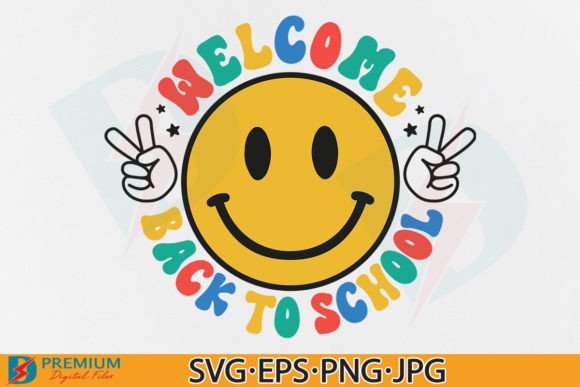
Welcome Back to School SVG, Kid 1st Day: A Practical Asset for Educators, Crafters, and Small Business Owners
Designing meaningful, on-brand back-to-school materials doesn’t have to mean starting from scratch—or sacrificing quality for speed. The Welcome Back to School SVG, Kid 1st Day is a purpose-built digital asset that bridges planning, production, and personalization in real-world creative and educational workflows. It’s not just decoration; it’s a functional component in how teachers prepare classroom welcomes, small business owners launch seasonal product lines, or crafters execute custom keepsakes—efficiently and consistently.
What This File Set Actually Delivers—and Why Format Variety Matters
You’ll receive one ZIP file containing six distinct files—each serving a specific role in your production pipeline:
- One high-resolution PNG (300dpi, transparent background): Ideal for layered digital layouts—think social media announcements, printable welcome signs, or digital newsletters where crisp edges and no background interference are essential.
- One optimized PNG (transparent, Cricut/Silhouette-ready): Pre-configured for cutting machines—no extra tracing or background removal needed. Saves time when prepping vinyl decals for backpacks, lunchboxes, or classroom doors.
- One JPG (300dpi, white background): Ready for quick uploads to print-on-demand platforms or email attachments where transparency isn’t supported—no last-minute editing required.
- One EPS vector file: Scalable without loss of fidelity. Critical if you’re resizing for large-format prints like banners or wall decals—or adapting the design for embroidery digitizing later.
- One grouped SVG file: Designed for seamless import into Cricut Design Space with elements locked together—ideal when you want to move or resize the entire composition as one unit.
- One ungrouped SVG file: Gives full control over individual letters, icons, or decorative elements—useful for color customization, rearranging layout, or integrating parts into larger composite designs.
This variety isn’t about redundancy—it’s about reducing friction across tools and tasks. You’re not choosing *one* format and hoping it fits every need. You’re selecting the right version for the job at hand, whether you’re batch-printing 50 student name tags or fine-tuning a tumbler decal for a boutique shop launch.
Where It Fits Into Real Workflows
For educators, this Welcome Back to School SVG, Kid 1st Day often appears early in August planning—before students arrive. It’s embedded into welcome packets, laminated hallway signs, or editable Google Slides used during orientation. Because the SVG and PNG files retain clean edges and legibility at any scale, teachers can resize confidently for projector slides (large) or desk tags (small) without pixelation or distortion.
For small business owners running craft-based shops—especially those using Printful, Gelato, or local screen printers—the EPS and high-res PNG files serve as production-ready assets. You upload the white-background JPG directly to Shopify product pages; use the transparent PNG for mockups in Canva; and rely on the EPS for vendor submissions requiring vector art. No reformatting. No delays.
Hobbyists and makers benefit most from the dual SVG options. If you’re using Cricut Design Space to cut vinyl for a child’s “First Day” photo frame, the grouped SVG preserves alignment. But if you want to swap the chalkboard-style font for a handwritten one—or add a star icon beside “Kid”—the ungrouped SVG lets you edit selectively, then re-export cleanly.
Compatibility Is a Planning Step—Not an Afterthought
Before importing or scaling, verify compatibility—not as a final check, but as part of your initial setup. Cricut Design Space supports both SVG formats natively, but older versions of Silhouette Studio require the Designer Edition to open SVGs without conversion. Adobe Illustrator handles EPS and SVG equally well, but free alternatives like Inkscape may render some stroke effects differently. Knowing this upfront avoids mid-project detours.
If you work across multiple devices—say, sketching ideas on an iPad with Affinity Designer, then finalizing in desktop software—test one file type first. Import the ungrouped SVG to confirm layer names and grouping logic match your expectations. That 10-minute test prevents hours of manual reassembly later.
Implementation Tips That Improve Consistency and Efficiency
Organize by use case, not file type. Instead of keeping all six files in one folder, create subfolders: /for-printing (JPG + EPS), /for-cutting (Cricut-optimized PNG + grouped SVG), and /for-editing (ungrouped SVG + transparent PNG). This mirrors how you’ll actually access them—and makes team handoffs smoother if you collaborate with designers or assistants.
Color and size changes are intentional features—not limitations. The ungrouped SVG lets you adjust individual fills, strokes, and opacity. Need pastel tones for a kindergarten theme? Change fill colors in seconds. Want bolder contrast for outdoor signage? Increase stroke weight on text outlines before exporting a new PNG. These aren’t compromises—they’re built-in flexibility points.
Use it as a consistency anchor across touchpoints. Apply the same design to a welcome banner, parent email header, and student name badge. That visual continuity reinforces messaging and builds trust—whether you’re a school communications coordinator or a homeschool blogger launching a “Back to Learning” resource bundle.
Long-Term Use and Ethical Integration
This is a digital-only, instant-download product—no physical item ships, no inventory is managed. That means your workflow stays lean: purchase, unzip, use. But long-term value depends on how you treat the license. You may customize, resize, and apply the design across unlimited physical products—t-shirts, mugs, stickers, pillows—but you may not resell or redistribute the digital files themselves. That boundary protects both the creator’s work and your own brand integrity. Using it ethically means treating it as a tool—not a commodity—and building something original around it.
Over time, consider documenting your adaptations. Did you combine the “Kid 1st Day” text with a custom illustration of your school mascot? Save that layered AI file separately. Did you convert the SVG into a Procreate brush for hand-lettered social posts? Note the export settings. These small documentation habits compound—making next year’s back-to-school prep faster, more consistent, and more uniquely yours.
Final Thought: It’s About Reducing Cognitive Load, Not Just Adding Graphics
The real utility of the Welcome Back to School SVG, Kid 1st Day lies in what it removes from your process: the mental energy spent redrawing letterforms, troubleshooting transparency issues, or second-guessing print readiness. It’s a verified, tested, production-aligned starting point—designed so you spend less time fixing files and more time engaging students, serving customers, or enjoying the creative act itself. When your tools align with your goals—not the other way around—that’s when preparation becomes impact.