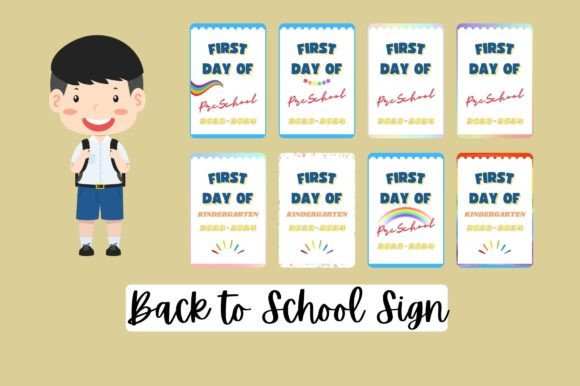
Back to School Sign Sheet: Instant-Download Visual Tools for Educators, Families, and Small Businesses
A Back to School Sign Sheet is more than a decorative prop—it’s a functional communication tool designed to mark transition, spark engagement, and support preparation across diverse learning and retail environments. Unlike generic seasonal signage, these curated digital files are purpose-built for flexibility, clarity, and immediate usability. With instant-download access to ultra-high-quality PDF, PNG, and JPG formats, users can print at home, in the office, or at a local print shop—no design software, no waiting, no subscription required.
Why Format Choice Matters in Real-World Use
The inclusion of three distinct file types—PDF, PNG, and JPG—is not arbitrary. Each serves a specific operational need:
- PDF: Preserves exact typography, spacing, and vector-based crispness at any scale. Ideal for printing large banners (e.g., 24″ × 36″) or multi-page sign sheets with consistent alignment. Teachers preparing classroom welcome displays often rely on PDFs to ensure text remains legible even when enlarged.
- PNG: Supports transparent backgrounds and lossless compression. This makes it perfect for digital overlays—think Zoom virtual classroom backdrops, social media announcements, or layered designs in Canva or Google Slides. A school PTA coordinator might drop a PNG version onto a newsletter header without white-box artifacts.
- JPG: Optimized for fast loading and broad compatibility. Best suited for email attachments, printed handouts, or embedded web graphics where file size matters more than transparency or scalability. A small business owner updating their storefront window display mid-August can email a JPG to their printer and have signs ready within hours.
This tri-format approach reflects real-world workflow diversity—not just aesthetic preference. It acknowledges that a single user may need all three: a teacher printing classroom labels (PDF), sharing a digital “First Day Countdown” graphic on Instagram (PNG), and emailing a simplified version to substitute staff (JPG).
Practical Applications Across User Groups
The versatility of a Back to School Sign Sheet becomes most evident when observed in context. Its value shifts meaningfully depending on who’s using it—and why.
Educators and School Staff
In classrooms and administrative offices, these signs function as both orientation tools and emotional scaffolds. A laminated “Welcome Back!” sign beside the door isn’t just decor—it signals routine restoration after summer’s open-ended rhythm. More substantively, sign sheets often include editable date fields, grade-level placeholders (“Room 204 — Grade 3”), or bilingual headers (English/Spanish), supporting inclusive, trauma-informed reentry practices. Some schools use coordinated sign sheets across hallways to reinforce themes like “Growth Mindset Starts Here” or “Our Library Is Open—Ask About Summer Reading Rewards.”
Families and Homeschoolers
For caregivers, the Printable Back to School Sign PDF transforms abstract anticipation into tangible ritual. Printing a “My First Day of 5th Grade” photo sign allows children to document milestones with intention—not just spontaneity. Homeschooling families integrate sign sheets into learning portfolios, using them as visual anchors for unit launches (“Science Lab Open — Weather Week Begins”) or behavior trackers (“Reading Streak: 12 Days”). Because files are downloadable and printable at home, there’s no delay between planning and implementation—a critical advantage during August’s compressed prep window.
Small Retailers and Community Organizations
Local bookstores, tutoring centers, and community centers leverage these signs for low-cost, high-impact environmental messaging. A corner bookstore might print a 11″ × 17″ “Back to School Supply List Station” sign to guide customers toward curated kits. A nonprofit running after-school programs uses a laminated sign sheet listing weekly themes (“Week 1: Digital Citizenship Bootcamp”) to build consistency across multiple locations. Crucially, because the files are ultra-high-resolution, signage retains professionalism whether printed on glossy poster paper or matte vinyl—no pixelation, no blurry edges.
Design Integrity Meets Functional Clarity
What distinguishes a well-crafted Back to School Sign Sheet from generic clipart collections is its attention to cognitive load and visual hierarchy. Effective versions avoid overcrowding; they use generous white space, intentional font pairing (e.g., bold sans-serif headlines with readable serif body text), and color palettes calibrated for accessibility—not just aesthetics. Many include optional grayscale versions, enabling cost-effective black-and-white printing without sacrificing legibility.
Contrast ratios meet WCAG 2.1 AA standards in top-tier sign sheets, ensuring readability for students with visual processing differences or aging faculty members. Icons—when used—are universally recognizable (e.g., an open book, a backpack, a graduation cap) rather than culturally narrow or overly stylized. There’s no reliance on fleeting trends; instead, design choices prioritize longevity across grade levels and institutional contexts.
Implementation Without Friction: The Power of Instant Download
“Instant download” isn’t marketing fluff—it’s a response to time-sensitive educational workflows. Unlike custom design services requiring revisions and approval cycles, a Printable Back to School Sign PDF bridges the gap between idea and execution in under two minutes. A principal noticing low parent turnout at orientation night can download, customize a “We’re Glad You’re Here” sign sheet, print five copies, and post them at key entry points before the event begins.
This immediacy also supports iterative improvement. Educators report printing test versions on standard letter paper first—checking alignment, font size, and color fidelity—before committing to larger formats. Because files are delivered digitally, updates (e.g., correcting a typo, adding a new grade level) are seamless: re-download, re-print, replace.
Considerations Beyond Print: Accessibility and Adaptation
While print remains central, thoughtful sign sheets anticipate hybrid and inclusive needs. Some include QR codes linking to digital resources—such as a school’s supply list spreadsheet, video tour of classroom routines, or multilingual family handbook. Others embed alt-text descriptions in PDF metadata, supporting screen reader navigation for visually impaired staff or parents.
Adaptability extends beyond format. Educators regularly crop or combine elements—for example, isolating a “Student of the Week” badge from a full sign sheet to use in a digital bulletin board. Designers who build these assets intentionally leave margins uncluttered and elements modular, enabling such repurposing without distortion.
Sustainability and Cost Awareness
Home printing empowers budget-conscious users. A district with limited communications funds can produce dozens of cohesive signs for under $5 in ink and paper—far less than outsourcing to a vendor. Likewise, families avoiding last-minute store runs save both money and time by printing essential signs (e.g., “Lunchbox Label Template,” “Homework Station Rules”) alongside academic materials.
Environmentally, digital-first distribution reduces physical waste. No shrink-wrapped plastic, no excess packaging, no unsold inventory ending up in landfills. Users print only what they need, when they need it—aligning practicality with growing institutional ESG priorities.
Looking Ahead: Evolving Expectations for Educational Signage
As learning environments diversify—blended classrooms, micro-schools, pop-up learning hubs—the demand for adaptable, human-centered visual tools grows. Future iterations of Back to School Sign Sheets may incorporate dynamic elements: editable fields compatible with PDF form fillers, layered PSD files for advanced designers, or even AR-enabled versions where scanning a sign triggers a welcome message or orientation video.
Yet core utility remains unchanged: clarity of purpose, respect for user time, and fidelity to educational values. Whether announcing a new literacy initiative, welcoming refugee students with translated greetings, or marking the quiet pride of a senior’s final first day, these signs serve as quiet catalysts—anchoring transitions, affirming belonging, and making the intangible rhythms of education visibly, warmly, unmistakably present.